

Bentley Continental GT Air Suspension Problems: Signs, Causes and the Parts That Fix Them
Dated : 21 Nov, 2026
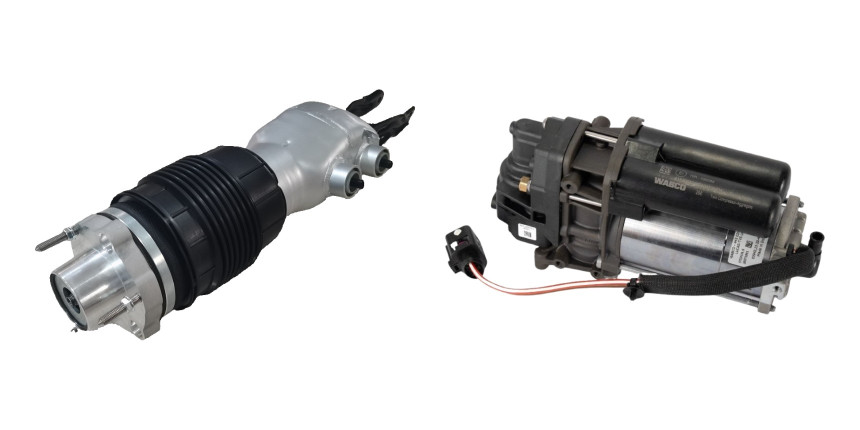
If your Continental GT sits low on one corner after a night parked, or the dash shows a suspension fault, the air suspension has either a leak or a part that has stopped working. On most cars it comes down to one of four things: an air strut, the compressor, the valve block or an air line. This guide explains how to tell which one it is, and lists the part numbers for the 2004 to 2017 cars and the 2018-on cars.
How does the air suspension on a Continental GT work?
Each corner of the car sits on an air strut: a rubber air spring wrapped around a shock absorber. An electric compressor pumps air through a valve block, which sends it to whichever corner needs it. A level sensor at each wheel tells the control unit how high that corner is, and the system adds or releases air to keep the car level and to change ride height. The first-generation cars also have a pressure accumulator, a small reservoir that lets the car lift quickly without waiting for the compressor.
On the 2018-on Continental GT, the rear air spring and the rear shock absorber are separate parts, so each can be replaced on its own. That changes which parts you order, so check your car's year before you buy anything.
What are the signs of air suspension problems?
- One corner sits lower than the others after the car has been parked for a few hours.
- The whole car is low in the morning and rises slowly once the engine is running.
- The compressor runs for a long time, runs often, or sounds louder than it used to.
- A suspension fault message on the dash, or the car will not change height.
- A floaty, bouncy or knocking ride, which usually means the shock absorber inside the strut is worn even if the air spring holds pressure.
What causes Bentley air suspension to fail?
The rubber air springs are the most common failure. They flex millions of times, sit close to hot brakes and exhaust parts, and crack with age. Small cracks often leak only in cold weather, when the rubber shrinks, which is why many owners first notice the problem on a winter morning.
A leak then wears out the compressor. Every time the car drops, the compressor has to refill it, so it runs far more than it was designed to. That is the reason to fix a leak quickly: a strut leak left for months often ends with a strut and a compressor to replace instead of just the strut. Less often, the fault is in the valve block, an air line fitting, or a level sensor that sends the wrong height to the control unit.
How do you find an air suspension leak?
- Measure from the center of each wheel to the edge of the fender in the evening, then again the next morning. The corner that has dropped most is where to start.
- With the car at its normal height, spray soapy water over the rubber air spring, the top of the strut, the air line fittings and the valve block. Bubbles show the leak.
- Note how long the compressor runs after you start the car. A compressor that runs every time the car is parked for a short while points to a leak somewhere in the system.
- Read the fault codes with a diagnostic tool that can access the suspension control unit. A level sensor fault looks very different from a pressure fault.
- Before you lift the car on a jack or a lift, switch on the jacking mode described in your owner's handbook, so the system does not try to level the car while it is in the air.
Which air strut fits my Continental GT?
Bentley used different struts for the coupe, the GTC convertible and the Flying Spur sedan, and changed them when the second-generation car arrived. These are the struts we stock, as listed on each part:
- Continental GT 2004 to 2010, front, standard models: 3W0616039M left and 3W0616040M right.
- Continental GT 2004 to 2012, rear: 3W0616001C left and 3W0616002C right.
- Continental GTC 2005 to 2011, rear, including Speed and Supersports: 3W7616001A left and 3W7616002A right.
- Continental Flying Spur 2005 to 2013: front 3W5616039M left and 3W5616040M right; rear 3W5616001C left and 3W5616002C right.
- Continental GT 2012 on (second generation): front 3W8616039L left and 3W8616040L right; rear 3W8616001G left and 3W8616002G right.
- Continental GT 2018 on: front air struts 975616037H left and 975616038H right; rear air springs 971616025H and 971616026H, with the separate rear shock absorber 975513035J.
Speed, Supersports and later model years can use different versions, and the number on your old strut may be an earlier one that has since been replaced. Send us the VIN and we will match the exact strut. The full list is in our Continental GT suspension section and, for 2018-on cars, the 2018 to 2026 suspension section.
Compressor, valve block and the smaller parts
If the compressor is tired, the car rises slowly or the system shows a fault even after a leak is fixed. For the first-generation Continental GT, GTC and Flying Spur we stock the air suspension compressor 3D0616005Q, which replaces 3D0616005H, K, L, M and P. The 2019-on Continental GT uses compressor 971616006H.
The valve block shares out the air. On 2004 to 2017 cars it is the valve unit 3D0616013C; on the 2019-on GT it is the valve block 971616056C. The smaller parts that cause slow leaks or false faults on the earlier cars are the pressure accumulator 3W0616201A, the level sensor 3W0616571, and the air lines 3W0616715C, 3W0616719D and 3W0616720D.
Should you replace air struts in pairs?
If one strut has failed on a car with high mileage, the other strut on the same axle is the same age and has done the same work, so it is often close behind. Replacing them as a pair keeps the damping even from side to side, which matters on a heavy, fast car. At the very least, check the other side carefully while the car is up.
When you replace a strut on a car that has been dropping for a while, check the compressor too. If it has been running hard, it may fail soon after the new strut goes in. If a level sensor is replaced, the ride height has to be set again with a diagnostic tool.
Is there a reset for Bentley air suspension?
No reset will fix a car that sags. A fault message that appears after the car has dropped usually clears once the leak is fixed and the system can hold pressure again. Stored fault codes can be read and cleared with a diagnostic tool that supports Bentley. If the message comes back, the fault is still there.
Air suspension wear is one of the main costs of keeping a Continental GT on the road, along with brakes and cooling parts. Our Continental GT reliability guide and our high-mileage guide explain what else to expect as the car gets older, and our Flying Spur parts guide covers the sedan.
Order the right air suspension part
Tell us which corner is dropping and what the dash says, and send us the VIN. We will match the strut, compressor or valve to your exact car.
Call us on +1 845 595 9822 seven days a week, 7am to 8pm, message us on WhatsApp at the same number, or email joe@exoticcarparts.com with your VIN, and we will confirm the correct part before your order ships.